4th Edition · Indian Space Association
Indian
DefSpace
Symposium 2026
Strengthening India’s Defence and Space Industry Synergy
23–24 April 2026 · Manekshaw Centre, New Delhi
4th Edition · Indian Space Association
Strengthening India’s Defence and Space Industry Synergy
23–24 April 2026 · Manekshaw Centre, New Delhi
Indian DefSpace Symposium 2026
The 4th Indian DefSpace Symposium 2026 brought together India’s foremost defence leaders, policymakers, and space industry pioneers for two days of strategic dialogue and collaboration at the Manekshaw Centre, New Delhi.
The symposium focused on strengthening the synergy between defence capabilities and emerging space technologies to build a resilient, future-ready national security ecosystem.
Strategic Discussions
Industry Leaders
Integrated Ecosystem
Opening Address
Chief of Defence Staff, India
General Anil Chauhan delivered the inaugural address at the Indian DefSpace Symposium 2026, highlighting the growing importance of integrated space capabilities, defence preparedness, and public-private collaboration in strengthening India’s national security framework.
Day 1 • 23 April 2026
The opening day of the Indian DefSpace Symposium 2026 focused on the strategic role of commercial space capabilities in defence preparedness, military operations, and national security.
10:15 – 11:30 hrs
Strengthening India’s Defence and Space Industry Synergy
General Anil Chauhan PVSM, UYSM, AVSM, SM, VSM, Chief of Defence Staff (CDS)
The Inaugural Session of the Indian DefSpace Symposium 2026 set the strategic tone for the conference by bringing together senior military leadership, policymakers, defence scientists, and industry stakeholders to deliberate on the future of India’s defence-space ecosystem.
Centred around the theme “Strengthening India’s Defence and Space Industry Synergy” , the session highlighted the growing importance of deeper collaboration between the armed forces, government institutions, research organizations, and the private space industry in building resilient national capabilities. :contentReference[oaicite:0]{index=0}
The discussion underscored how space has evolved into a critical operational domain influencing communications, intelligence, surveillance, navigation, targeting, and strategic deterrence in modern warfare.
Senior leaders emphasized the need for India to accelerate indigenous defence-space capabilities, strengthen strategic autonomy, and create a robust industrial ecosystem capable of supporting future multi-domain military operations.
The session also reflected on recent collaborative initiatives between the Defence Space Agency (DSA) and the Indian Space Association (ISpA), including the DefSpace Capability Dialogue, which enabled direct engagement between defence stakeholders and India’s private space sector.
Key themes included public-private partnerships, defence innovation, strategic technology development, commercial participation in national security missions, and the role of emerging space technologies in enhancing operational readiness and decision superiority.
The inaugural proceedings reinforced the importance of integrating defence requirements with commercial innovation to position India as a major space power capable of meeting future security challenges across terrestrial and orbital domains.
09:30 – 10:15 hrs
(Chinese Space Technologies and the Civil-Military Fusion Model)
Brig Anshuman Narang (Retd), Founder & Director, Atmanirbhar Soch, Advisor, Suhora Technologies
China’s rapid advancements in space capabilities have emerged as a defining factor in the evolving strategic and military balance across the Indo-Pacific region.
This session examined the structure and operational dynamics of China’s Civil-Military Fusion (CMF) model, highlighting how the seamless integration of commercial industry, state-backed enterprises, research institutions, and military organizations has accelerated Beijing’s ambitions in space.
The discussion explored the expanding role of Chinese space technologies in intelligence gathering, satellite communications, navigation, Earth observation, electronic warfare, and strategic military support operations.
Particular emphasis was placed on understanding how China leverages commercial innovation and dual-use technologies to strengthen military readiness, space resilience, and operational dominance across multiple domains.
The session also addressed the strategic implications of China’s growing orbital presence, counter-space capabilities, and integrated surveillance architecture for regional security and future conflict scenarios.
Drawing from global developments and emerging threat patterns, the presentation highlighted key lessons for India’s defence and private space ecosystem, underlining the importance of indigenous capability development, strategic autonomy, and closer defence-industry collaboration.
11:30 - 12:45 hrs
(Use of Space in Recent Conflicts: An Analysis and Lessons for Industry)
Lt Gen Dushyant Singh, PVSM, AVSM (Retd), Director General, CLAWS
Air Vice Marshal DV Khot AVSM VM (Retd), Principal Consultant & Director, SP, IN-SPACe
The past decade has witnessed a fundamental transformation in how space underpins military operations. From the satellite-enabled precision campaigns in the West Asia conflict, to the unprecedented commercial space involvement in the Russia-Ukraine war, to India's own experience in Operation Sindoor - space has moved from a strategic background enabler to a decisive operational asset on the front line of modern conflict.
This session examined three distinct conflict case studies to derive lessons relevant to India’s evolving defence space posture and the industry supporting it.
Discussions focused on how space capabilities enabled operations across land, sea, and air domains through communications, ISR, PNT, early warning, and targeting systems.
The panel also analysed vulnerabilities exposed during recent conflicts, including electronic warfare, cyber attacks on space systems, and the targeting of commercial satellites critical to military operations.
Digantara contributed a data-driven perspective on hostile activities in orbit, including proximity operations, on-orbit interference, and the broader threat landscape affecting both military and commercial satellite infrastructure.
12:45 - 13:15 hrs & 17:10 - 17:20 hrs
The Industry Sessions on Day 1 of the Indian DefSpace Symposium 2026 highlighted the growing role of commercial space enterprises in strengthening India’s defence and strategic space capabilities. These focused presentations enabled participating organisations to showcase advanced technologies, operational solutions, and emerging applications relevant to modern defence-space requirements.
Discussions centred around resilient satellite communications, Earth observation technologies, ISR applications, space-based analytics, and the operational integration of commercial capabilities into military and national security ecosystems. :contentReference[oaicite:0]{index=0}
Eutelsat OneWeb presented perspectives on secure and resilient low Earth orbit (LEO) communication networks and their role in enabling reliable connectivity for defence operations, particularly in remote and contested environments.
Pixxel showcased advancements in hyperspectral imaging technologies and next-generation Earth observation systems capable of supporting intelligence gathering, environmental monitoring, and strategic decision-making.
Virat Group highlighted indigenous industrial capabilities supporting India’s growing aerospace and defence ecosystem, reinforcing the importance of domestic manufacturing, technological self-reliance, and scalable infrastructure development.
Synspective contributed insights into advanced SAR-based Earth observation systems and persistent monitoring solutions, emphasizing the increasing importance of real-time geospatial intelligence in defence preparedness and multi-domain operations. :contentReference[oaicite:1]{index=1}
Collectively, the Industry Sessions demonstrated how commercial innovation, private-sector participation, and strategic technology partnerships are becoming essential pillars of India’s future defence-space architecture.
14:15 - 15:30 hrs
Air Vice Marshal Pawan Kumar VM (Retd), Former DG, DSA
As India advances towards becoming a space-enabled military power, the role of resilient and secure space-based communication networks has become central to national defence strategy.
This session examined the evolving requirements of military communication networks underpinned by space assets, including satellite communications, LEO and GEO constellations, and integrated multi-domain operations.
Against the backdrop of India’s diverse operational terrain - ranging from high-altitude mountain regions and remote border areas to the expansive Indian Ocean Region (IOR) - discussions focused on the need for seamless, jam-proof, and cyber-resilient connectivity.
The panel addressed the regulatory and security dimensions of satellite communications in India, including Department of Telecommunications (DoT) guidelines and the alignment between industry and defence establishments to meet operational standards.
Participants also explored the comparative merits and economics of LEO versus GEO networks for defence applications, analysing latency, coverage, cost-efficiency, redundancy, and survivability in contested operational environments.
Special attention was given to emerging LEO constellations and their growing role in enabling network-centric warfare and multi-domain operations (MDO).
The session concluded with insights into how commercial space communication technologies can strengthen India’s defence operational readiness through real-time situational awareness, secure command and control, and seamless joint-force coordination across domains.
16:00 - 17:10 hrs
Air Vice Marshal Sanjay Bhatnagar VM(G) VSM (Retd), Former ACIDS Tech Int, HQ IDS and ACAS Ops (Offensive), Air HQ, Former Advisor BEL
Modern military operations increasingly rely on space-based Intelligence, Surveillance, and Reconnaissance (ISR) systems to achieve information dominance and decision superiority in contested operational environments.
This session explored the strategic significance of space-enabled ISR capabilities across land, air, maritime, and cyber domains, highlighting how advanced satellite systems are transforming battlefield awareness and operational responsiveness.
Discussions focused on the integration of high-resolution Earth observation, synthetic aperture radar (SAR), persistent surveillance, and near real-time intelligence dissemination into military command structures.
Panelists examined how ISR-driven decision-making enables faster operational cycles, enhanced targeting precision, and coordinated multi-domain responses in complex and rapidly evolving conflict scenarios.
The session also addressed the challenges associated with operating in contested environments, including electronic warfare, signal denial, cyber threats, anti-satellite risks, and the growing vulnerability of critical space infrastructure.
Industry leaders shared perspectives on emerging commercial ISR technologies, resilient satellite architectures, data fusion platforms, and AI-driven analytics that can support India’s defence preparedness and strategic autonomy.
The discussion reinforced the importance of close collaboration between defence agencies and private industry in building scalable, resilient, and mission-ready ISR ecosystems capable of supporting future military operations.
17:25 - 17:40 hrs
As defence and space technologies become increasingly capital intensive, the role of strategic financing and long-term investment frameworks has emerged as a critical enabler for the development of sovereign military-space capabilities.
This industry talk examined the evolving financial ecosystem supporting ELINT systems, ISR satellite constellations, and dual-use space technologies, highlighting the growing need for innovative investment mechanisms capable of supporting high-risk and technology-driven space programmes.
Discussions focused on financing models that can accelerate indigenous capability development across satellite infrastructure, advanced payload systems, secure communications, surveillance platforms, and mission-critical defence-space technologies.
The speakers also explored the role of public-private partnerships, infrastructure financing, institutional investment, and strategic capital allocation in enabling long-term sustainability within India’s expanding defence-space sector.
Particular emphasis was placed on the importance of financial resilience and investment readiness in supporting emerging startups, advanced manufacturing ecosystems, and scalable commercial space capabilities with defence applications.
The session concluded with insights into how India can strengthen its defence-space financing ecosystem to support innovation, industrial growth, mission continuity, and strategic technological self-reliance in an increasingly contested geopolitical environment.
Day 2 • 24 April 2026
The second day of the Indian DefSpace Symposium 2026 focused on strengthening India’s defence operational readiness through deeper collaboration between the armed forces, policymakers, ISRO, DRDO, academia, startups, and the private space industry. Discussions explored future military space capabilities, mission readiness, policy frameworks, industrial participation, navigation resilience, and India’s long-term strategic vision for the defence-space ecosystem.
09:30 - 10:40 hrs
The plenary session set the strategic direction for Day 2 by focusing on India’s future defence-space readiness, operational integration, and industrial capability development.
Senior defence leaders, scientists, and policymakers discussed the importance of indigenous technologies, mission preparedness, and strategic collaboration between government institutions and the private space ecosystem.
10:40 - 11:10 hrs
Ms Devika Diwan, Senior News Editor, NewsX
Aligned with the theme of strengthening India’s defence and space industry synergy, this fireside chat brought a human-centric perspective to India’s evolving space ambitions.
Through discussions on rigorous astronaut training, mission simulations, and operational readiness, the session highlighted how human spaceflight is shaping national capability, technological depth, and long-term strategic preparedness.
The interaction also explored the expanding industry opportunities emerging from India’s human spaceflight programme, including high-reliability systems, crew training infrastructure, life-support technologies, advanced materials, and mission operations support.
As India progresses toward the Gaganyaan mission and future crewed space initiatives, panelists emphasized the importance of stronger collaboration between ISRO, defence forces, academia, startups, and private industry in building a resilient and scalable national space ecosystem.
The discussion further reflected on how human spaceflight programmes can act as catalysts for innovation, self-reliance, strategic technological advancement, and global competitiveness while contributing to the growth of a sustainable Indian space economy.
By linking astronaut preparedness with future missions and industrial participation, the session provided attendees with valuable insights into India’s future trajectory in human space exploration and the strategic pathways required to support it.
11:10 - 11:55 hrs
(A Conversation on India’s Defence Space Sector and Defence Vision 2047)
Chethan Kumar, Senior Assistant Editor – Space & Science, The Times of India
India’s journey in military space spans more than three decades — from the early use of communication satellites for defence applications to the creation of the Defence Space Agency (DSA) and the articulation of Defence Vision 2047.
This fireside chat examined India’s military space trajectory with candour — celebrating institutional and technological achievements while also critically analysing the gaps between long-term strategic vision and operational capability development.
Discussions explored the strategic imperatives that shaped India’s defence-space policies, the evolving relationship between civilian and military space infrastructure, and the role played by ISRO, DRDO, and the armed forces in developing indigenous space-enabled defence capabilities.
Panelists reflected on the institutional and policy challenges that have historically slowed progress, including inter-service coordination, procurement timelines, funding mechanisms, infrastructure limitations, and the delayed emergence of a dedicated military space doctrine.
The conversation also addressed the growing importance of India’s private defence-space ecosystem, highlighting the role of startups, advanced manufacturing, emerging technologies, and strategic industry participation in future capability development.
Particular emphasis was placed on the skills, innovation ecosystem, and human capital required to sustain a sovereign and mission-ready military space programme capable of supporting future operational requirements.
Looking ahead, the session examined what Defence Vision 2047 must concretely deliver in terms of resilient satellite systems, ISR capabilities, secure communications, navigation resilience, deterrence posture, and decision superiority to ensure India’s strategic autonomy in the decades ahead.
12:15 - 13:25 hrs
Air Marshal BR Krishna PVSM AVSM SC (Retd), Former CISC
This session focused on Mission DefSpace — India’s flagship initiative aimed at accelerating innovation, capability development, and strategic collaboration within the defence-space ecosystem.
Discussions provided updates on ongoing Mission DefSpace initiatives, highlighting progress in indigenous technology development, operational integration, startup participation, and the evolving role of private industry in strengthening national defence-space capabilities.
Panelists examined how collaborative frameworks involving the Defence Space Agency (DSA), iDEX, DRDO, academia, startups, and established industry players are enabling the development of mission-oriented solutions for future military operations.
The conversation also addressed key challenges associated with scaling defence-space innovation, including procurement timelines, operational validation, technology transition pathways, funding support, and long-term capability sustainment.
Particular emphasis was placed on the growing importance of agile startups and dual-use technologies in supporting operational readiness, resilient communications, ISR capabilities, space situational awareness, and decision support systems.
Industry representatives shared perspectives on strategic partnerships, emerging commercial opportunities, and the need for closer alignment between operational requirements and indigenous technological development.
The session concluded with discussions on the future roadmap for Mission DefSpace and the strategic steps required to strengthen India’s long-term defence-space preparedness, innovation ecosystem, and sovereign operational capabilities.
14:30 - 15:40 hrs
(IN-SPACe Policies, Demand Generation, Skilling, Infrastructure Support, Finance & Insurance for Space Missions)
Dr Vinod Kumar, Director, Promotion Directorate, IN-SPACe
India’s defence-space industrial base is currently at a transformative stage, driven by policy reforms, expanding private participation, and increasing strategic interest from both domestic and international stakeholders.
This session examined how recent reforms introduced by IN-SPACe have opened new pathways for industry participation across satellite manufacturing, launch systems, mission operations, downstream applications, and strategic defence-space services.
Discussions explored the critical transition from policy intent to operational payload capability, highlighting the structural and operational challenges that continue to affect the growth of India’s defence-space ecosystem.
Panelists addressed key issues including funding gaps, infrastructure limitations, technology readiness barriers, export restrictions, insurance mechanisms, regulatory clarity, and the need for sustained domestic demand generation to support long-term industrial growth.
Particular emphasis was placed on skilling, workforce development, and the creation of specialised talent pipelines capable of supporting advanced manufacturing, systems engineering, mission assurance, and space operations.
Industry leaders and international partners shared perspectives on how India can position itself as a globally competitive defence-space manufacturing and services hub by strengthening public-private partnerships, improving access to finance, enabling infrastructure support, and accelerating innovation ecosystems.
The session concluded with discussions on practical measures required to build a resilient and scalable defence-space industrial base capable of supporting India’s future strategic, commercial, and operational ambitions.
16:00 - 17:10 hrs
Air Vice Marshal Rahul Gupta, ACAS Ops (Space), Air HQ
Positioning, Navigation, and Timing (PNT) systems have become foundational to modern military operations, enabling precision targeting, synchronized manoeuvres, autonomous systems, secure communications, and real-time situational awareness across domains.
This session focused on the growing operational challenges associated with contested and electronically degraded environments, where reliance on conventional Global Navigation Satellite Systems (GNSS) exposes vulnerabilities such as jamming, spoofing, signal degradation, and complete denial of navigation services.
Discussions placed particular emphasis on India’s regional navigation system, NavIC, and its strategic role in strengthening national autonomy, operational resilience, and assured mission continuity in denied operational environments.
Panelists examined the operationalisation of NavIC across defence and civilian sectors, addressing challenges associated with adoption, integration, infrastructure readiness, interoperability, and long-term scalability.
The session also explored complementary and resilient navigation solutions, including multi-constellation GNSS integration, alternative PNT technologies, inertial navigation systems, terrestrial augmentation mechanisms, and secure timing architectures designed to ensure redundancy and survivability.
Discussions further addressed evolving electronic warfare threats, cyber risks, and the importance of developing secure, tamper-resistant navigation frameworks capable of sustaining operational continuity during high-intensity conflicts and contested missions.
Through perspectives shared by government, defence, ISRO, and industry leaders, the session identified strategic pathways for building a resilient, sovereign, and future-ready PNT ecosystem capable of supporting India’s long-term defence and strategic operational requirements.
17:10 - 17:30 hrs
The Closing Session marked the formal conclusion of the Indian DefSpace Symposium 2026, bringing together senior defence leaders, policymakers, industry representatives, academia, and strategic stakeholders to reflect on the discussions, collaborations, and strategic outcomes of the two-day symposium.
The session highlighted the growing importance of strengthening India’s defence-space ecosystem through deeper collaboration between the armed forces, government institutions, private industry, startups, and research organisations.
Speakers emphasised the need for sustained innovation, policy support, indigenous capability development, and operational integration to ensure India’s long-term strategic preparedness and technological self-reliance in the space domain.
The concluding discussions also reflected on the symposium’s central themes: mission readiness, resilient space infrastructure, industrial growth, sovereign capabilities, and the role of commercial space technologies in future military operations.
Launches at IDS 2026
IDS 2026 witnessed the launch and announcement of two major national-level initiatives focused on advancing India’s space education, innovation, aerospace research, and defence-space ecosystem.

International Launch
The International Space Science Olympiad (ISSO) 2026 was formally inaugurated during IDS 2026 as a global initiative aimed at fostering scientific curiosity, innovation, and interdisciplinary learning in space sciences among students and young researchers.
The initiative seeks to strengthen India’s role in promoting next-generation talent development in astronomy, aerospace, satellite technologies, and space research through international academic collaboration and competitive scientific engagement.

National Announcement
IDS 2026 also marked the announcement of the Indian National Aerospace and CanSat Challenge (INACC), an initiative designed to encourage hands-on aerospace engineering, systems design, and satellite mission development among students, startups, and emerging innovators.
The challenge aims to build practical capabilities in payload development, mission simulation, telemetry systems, and aerospace experimentation, while supporting the creation of a stronger indigenous aerospace innovation ecosystem.
IDS 2026 Exhibition
The exhibition at the Indian DefSpace Symposium 2026 showcased leading defence-space technologies, strategic capabilities, emerging startups, and next-generation solutions from India’s rapidly evolving aerospace and defence ecosystem.

.jpeg)








.png)


A walkthrough showcasing exhibition stalls, technology demonstrations, networking zones, and industry participation during IDS 2026.
Moments from the exhibition floor, live demonstrations, networking interactions, and technology showcases.
Key knowledge outputs and insights from the IDS ecosystem

Geospatial Foundation Models enable scalable intelligence from satellite data, transforming Earth observation into actionable insights across sectors like agriculture, infrastructure, and disaster response. By integrating multi-source datasets, they support faster decision-making and national-scale governance through consistent, AI-driven geospatial analysis.
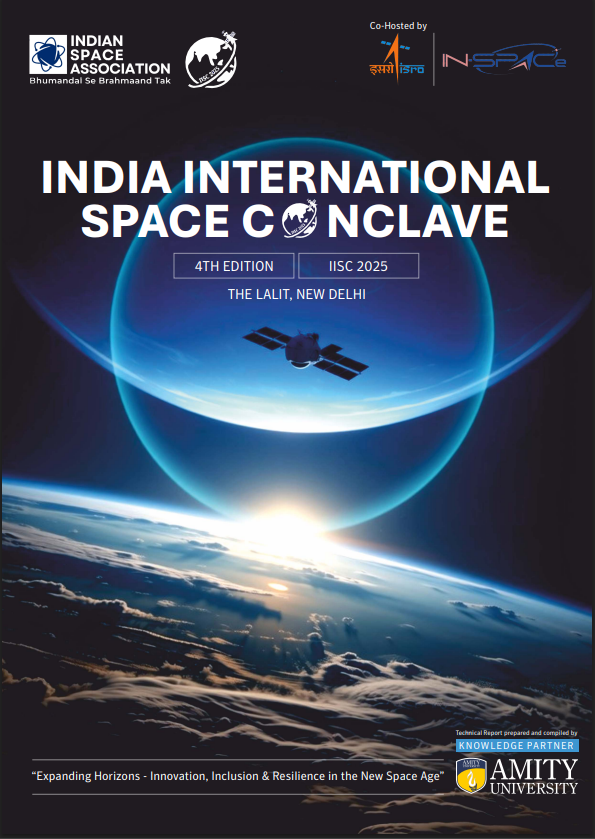
The conclave report highlights India’s growing role in the global space ecosystem through policy reform, innovation, and industry collaboration. It emphasizes investment opportunities, strategic partnerships, and technological advancement, positioning India as a key player in shaping the future of the global space economy.
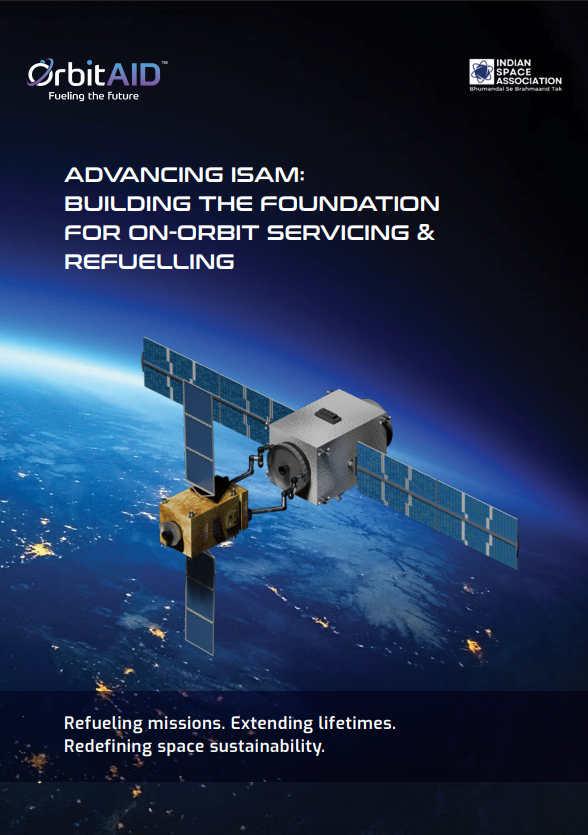
This report explores In-Space Servicing, Assembly, and Manufacturing as a foundational capability for the future space economy. By enabling satellite life extension, repair, and refuelling, ISAM shifts focus from launch to sustainability, offering India a strategic opportunity to lead in next-generation space infrastructure.
We extend our sincere appreciation to our sponsors, partners, and supporters who made IDS 2026 possible.








.png)

.jpeg)

























See You Again at India International Space Conclave 2026